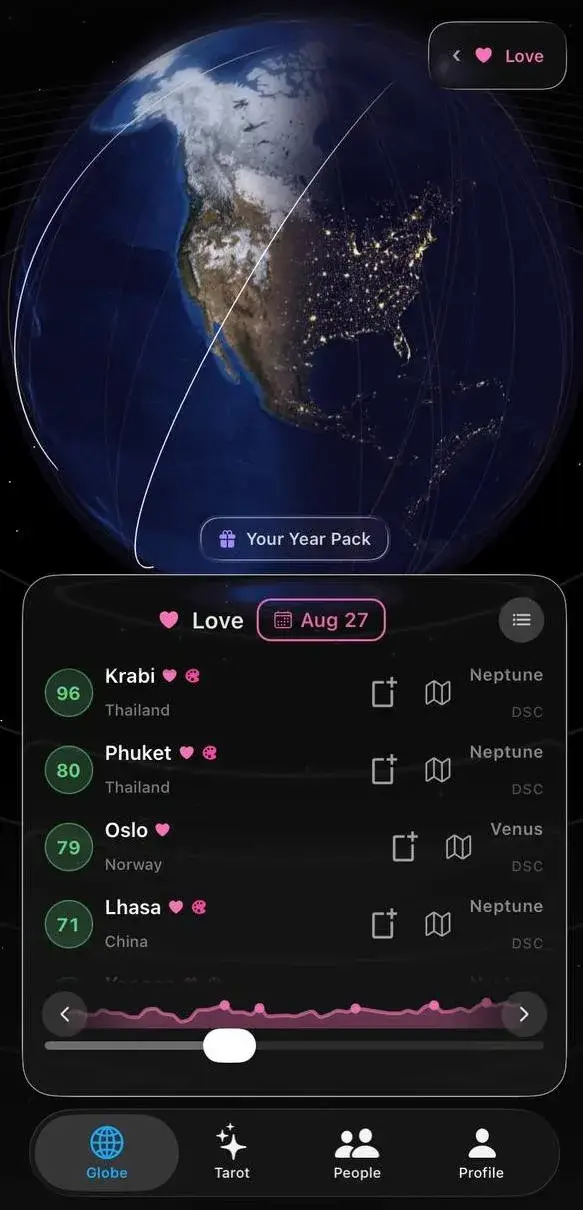

Astrocartography is the idea that the planets from your birth chart don't just sit inside a wheel — they also draw lines across the real world. Each line marks a place where a particular planet was sitting on your horizon the moment you were born. Walk into it, and that planet's flavour colours your experience there.
This guide is the short version of a 100-year-old technique. Four sections, about a five-minute read: what the map actually is, the four lines worth knowing, how to read them, and the mistakes people keep making.
What astrocartography actually is
Your birth chart is a photograph of the sky at the exact moment you were born. Astrocartography takes that photograph and re-projects it onto a map of the Earth.
For each of the ten planets, it draws four lines — one for each astrological angle:
- Rising (Ascendant)
- Setting (Descendant)
- Culminating (Midheaven)
- At the bottom of the sky (IC, or nadir)
Forty lines total. In practice, most people only pay close attention to four or five of them. The technique was formalised by astrologer Jim Lewis in the 1970s, and modern apps — including Meridy — now plot it in seconds.
The premise: the closer you are to a line, the more strongly that planet's themes show up in your life there.
The four lines worth knowing
Ten planets × four angles = forty possible lines. Here are the four that do most of the work.
Sun line — where you're visible
Your Sun line is where your ego, confidence, and public self want to come forward. People describe their Sun lines as cities where they feel seen — sometimes pleasantly, sometimes not. Good for reputation-building, launching a project, stepping into a role. Bad if you're trying to disappear.
Venus line — where things soften
Venus is love, beauty, art, and ease. On a Venus line, pleasure lands easier; food tastes better; relationships tend to show up. Not always romantic — for some people it shows up as a creative renaissance or a friendship that reshapes them. For the deeper read on this one, see our Venus line guide.
Jupiter line — where life opens up
Jupiter is expansion, opportunity, optimism. Doors open more easily here. Random introductions go somewhere. Money often improves. The flip side: Jupiter also expands things you'd rather keep small — indulgence, overconfidence, biting off more than you can chew.
Saturn line — where you meet the floor
Saturn is structure, discipline, limits. Not bad, but heavy. Life asks more from you here — responsibility, focus, maturity. People often describe their Saturn cities as the places where they “had to grow up.” If a Venus line is a weekend in Paris, Saturn is where you finish your doctorate.
How to read your map
Three things matter when you look at your astrocartography:
- Proximity. Within roughly 700 miles (1,100 km) of a line is the traditional orb — the zone where the line's influence is strong.
- Which angle it's on. A Venus-rising line (on the Ascendant) pulls Venus into your personality and relationships. Venus-on-the-Midheaven pulls it into your career and visibility. Same planet, very different delivery.
- How it interacts with the rest of your chart. A Jupiter line is usually gentle, but if Jupiter is squared by Saturn in your birth chart, the line still carries some overreach. Astrocartography amplifies what's in your chart; it doesn't override it.
For a practical walkthrough of turning this into a decision, see our guide to using astrocartography for relocation.
Common mistakes
- Chasing a Venus line to fall in love. Sometimes works, often doesn't. You take yourself with you.
- Running from your Saturn line. Saturn lines are uncomfortable precisely because that's where your growth is. Avoiding them has its own cost.
- Moving somewhere without visiting first. Lines are real, but so are weather, cost of living, language, and community.
- Treating the map as destiny. Astrocartography shows probabilities, not guarantees. Two people on the same Venus line will have wildly different experiences depending on what they bring to it.
Getting your own map
Until recently, a usable astrocartography map meant paying a professional or wrestling with desktop software built for astrologers. The lines are straightforward trigonometry; the interpretation is where people got lost.
Meridy was built for that gap. Enter your birth data once — date, time, place — and the app plots every planetary line on a real world map, names the cities each line passes through, and writes a plain-English read of what each location tends to ask of you. No symbols to look up. No desktop software.
Try Meridy → Your map is free to generate. Download on iOS.