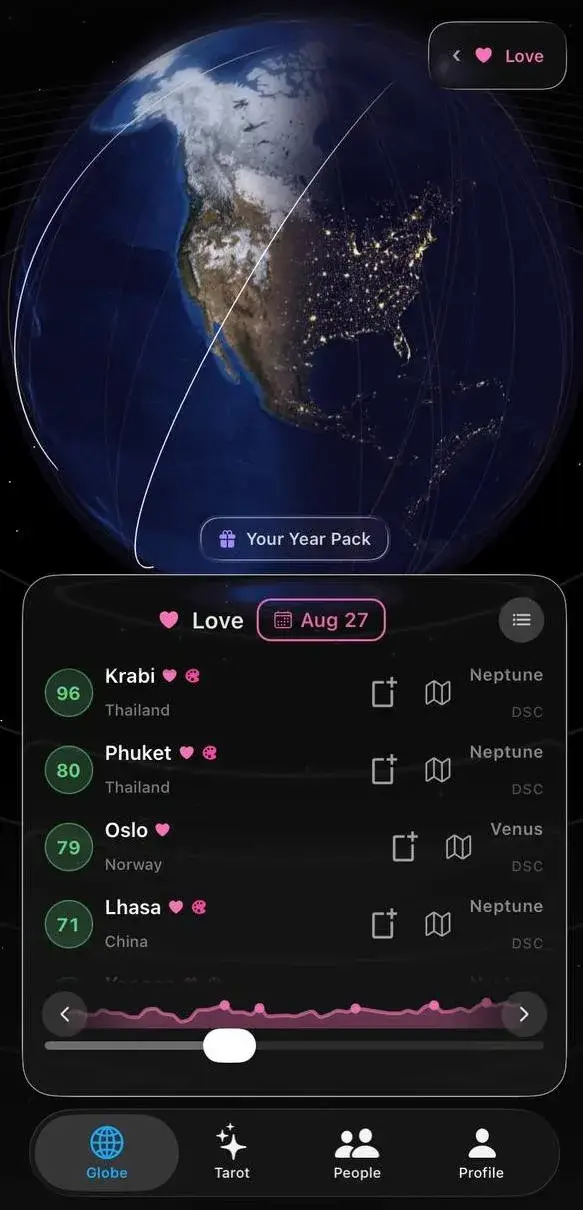

At some point, most people ask the question sideways: why do I feel so different in some cities? Some places wake you up. Others flatten you. You don't always know why.
Astrology has two techniques for this, and they're different enough to be worth separating:
- Astrocartography — your birth chart projected onto the world as planetary lines.
- Relocation astrology — your entire chart re-cast as if you'd been born somewhere else.
Both answer a version of the same question. Most modern apps (including Meridy) lean on astrocartography because it's easier to see. This guide walks through how to actually use either approach when you're considering a move.
Astrocartography vs relocation chart
Astrocartography shows you the sweep. On a single map, you see every planet's lines across the Earth. Good for quick decisions and for comparing a shortlist of cities.
Relocation chart shows you the detail. You re-cast your chart to a specific latitude/longitude, and every planet gets reassigned to houses based on your new horizon. Good for deep analysis once you've picked a city.
In practice, most people use astrocartography to narrow down to two or three cities, then pull a relocation chart for the finalists.
Step 1: Know what you actually want
Relocation astrology is a tool. The question it can't answer is what you want. Start with that.
Meridy breaks it into nine life areas, which roughly map to what planetary lines do best:
| If you want… | Look at… | What the line does |
|---|---|---|
| Love | Venus (esp. DC) | Relationships show up more easily |
| Career | Sun, Jupiter on MC | Visibility, promotion, expansion |
| Home | Moon, Venus on IC | Comfort, emotional rootedness |
| Growth | Jupiter | Doors open, new horizons |
| Spirit | Neptune, Moon | Contemplation, retreat |
| Money | Jupiter (esp. MC), Pluto | Opportunity, wealth |
| Creativity | Venus, Mercury, Neptune | Art, ideas, inspiration |
| Travel | Jupiter, Uranus | Movement, adventure |
| Challenge | Saturn | Growth via difficulty |
The line that's “best” depends entirely on which of these you're actually chasing. A Saturn line isn't a bad place — it's where you go if you want to build something hard. Same for Pluto: not “bad,” just heavy.
Step 2: Map your lines
Next, plot your astrocartography. You need three pieces of data: birth date, birth time (to the minute if possible — even 15 minutes off can move lines by hundreds of miles), and birth place.
From there, any competent app gives you forty lines across the world. Meridy does it in seconds; desktop programs like Solar Fire do it with more precision if you're already an astrologer.
Look for two things:
- Which of your lines fall near cities you'd consider. A city you can't realistically live in is the wrong city, even if it has a perfect Venus line.
- What angle the line is on. Venus-Ascendant and Venus-Descendant deliver very different experiences. (See the Venus line guide for specifics.)
Step 3: Check the orb
The classical orb for astrocartography is about 700 miles (1,100 km). Within that radius the line is active; beyond it, the effect fades quickly.
A few reference points:
- 0–200 miles: Very strong. The line's themes will dominate.
- 200–500 miles: Strong. Clearly noticeable.
- 500–700 miles: Moderate. Present but quieter.
- 700–1,100 miles: Weak. You may feel it; you may not.
- More than 1,100 miles: The line is functionally inactive.
You can also pay attention to parans — latitudes where two planetary lines cross. Parans are specific to a latitude band (not a single city), and they carry combined energy. A Venus-Jupiter paran at 40° N is different from Venus alone.
Step 4: Cross-reference with your natal chart
Astrocartography amplifies what's already in your chart. It doesn't override it.
If your natal Venus is under hard aspects from Saturn, your Venus line will still bring Venus themes — but they'll carry weight. If your natal Sun is well-aspected, your Sun line delivers more cleanly. This is the step desktop astrologers spend hours on; Meridy flags the strongest cross-references automatically.
Life-area examples
“I want to find a partner.”
Start with your Venus-DC line. Cross-reference with Mars lines (for chemistry) and Moon lines (for emotional compatibility). Avoid moving to Saturn-DC unless you're specifically ready for a serious, slow-burn partnership.
“I want to level up my career.”
Sun-MC or Jupiter-MC. For creative fields, add Venus-MC. Be aware that Saturn-MC is not “bad career” — it's career discipline. It delivers results over time but tests you first.
“I want a quieter life.”
IC lines in general — Moon-IC, Venus-IC, Neptune-IC. Avoid hard lines on the Ascendant (you'll feel more “on” than you want).
“I want to write a book.”
Mercury lines on any angle. Neptune-MC or Neptune-IC if you need the dreamier, more imaginative register.
Common mistakes
- Moving for a line you haven't visited. Two weeks first. At least.
- Ignoring practical factors. Cost of living, language, community, family. The line doesn't override your life.
- Treating the line as destiny. It's a probability shift, not a guarantee. You still have to show up.
- Over-indexing on one line. Most interesting cities have overlapping lines. Read the combination, not the single line.
- Chasing a Venus line to fall in love. Common enough that it deserves its own warning. Venus lines make love more likely, not certain.
Frequently asked questions
Is relocation astrology legit?
Depends what you mean. As a deterministic predictor of your future, no. As a framework for noticing which places ask more or less of you, yes — enough practitioners and long-term users describe consistent patterns that it's worth using as an input. Not the input — one of several.
How long do I have to stay for a line to “work”?
Effects start within a few days. They deepen over months. For a full read, astrologers traditionally suggest at least a lunar cycle (roughly 28 days). For major life decisions, don't move somewhere you haven't lived in for at least three months.
Can I just visit my lines instead of moving?
Yes, and for most people this is the better move. Travel through your strongest lines before committing to relocation.
My Saturn line passes through a city I love. What does that mean?
Probably that the city has already asked something of you, and you met the ask. Saturn lines aren't bad — they're heavy. If you've thrived on one, you've already answered Saturn.
Do I need an app, or can I calculate this myself?
You can calculate it yourself with a program like Solar Fire or Astro-Seek's free tool. You'll need your exact birth time and a working knowledge of astrology to interpret the results. Meridy bundles the math and the interpretation — no chart-reading skill required.
Deciding
Relocation astrology is most useful as one input in a larger decision. People who rely on it exclusively usually end up disappointed; people who ignore it completely sometimes miss something real. The sweet spot is using it alongside the rest of your life: your work, your money, your relationships, your actual preferences.
If you're seriously considering a move, pull your astrocartography map, pick the two or three cities that cross good lines and that you could reasonably live in, and visit them. See what the line feels like at ground level.
Try Meridy → Your full astrocartography map is free to generate. Download on iOS.
Related reading:
- Astrocartography Explained — the primer if you're new to planetary lines
- Your Venus Line — deep dive on the line people ask about most